

Most claim denials are preventable, yet they persist at scale. This isn’t a failure of effort; it’s a failure of system design. When errors are allowed to move through the revenue cycle unnoticed, the impact is already set long before a payer issues a rejection.
By the time a claim is denied, revenue is delayed and a costly rework cycle begins. This is why denial management, as a standalone strategy, falls short.
Hospitals that achieve meaningful reductions don’t focus on fixing claims. Instead, they fix the system that produces them.
How Top Hospitals Manage Their Revenue Cycle
Top-performing hospitals treat revenue cycle management as a controlled system, not a series of disconnected tasks.
Their focus is simple: prevent errors before they move downstream. What sets them apart is how the system operates:
- Front-end accuracy is enforced early: Patient data, eligibility, and authorizations are verified before services are billed.
- Workflows are aligned across departments: Clinical documentation, coding, and billing operate within one continuous process.
- Claims are validated before submission: Errors are identified and corrected before reaching the payer.
- Performance is actively monitored: Issues are tracked in real time with clear accountability.
The result is a revenue cycle that minimizes denials by design.
Where Claim Denials Actually Start
Claim denials don’t start at submission. Most denials can be traced back to a small number of breakdown points across the revenue cycle:
- Registration and eligibility: Incomplete or incorrect patient and insurance data creates errors that carry through the entire claim.
- Authorization and coverage validation: Missing or incorrect pre-authorizations lead to automatic rejections.
- Clinical documentation and coding: Inaccurate or inconsistent records result in coding errors and non-compliant claims.
- Pre-submission validation: Claims that are not properly checked against payer rules are sent with avoidable issues.
Each of these points introduces risk. When left unaddressed, those risks compound until they surface as a denial.
Why Traditional RCM Approaches Fail to Reduce Denials
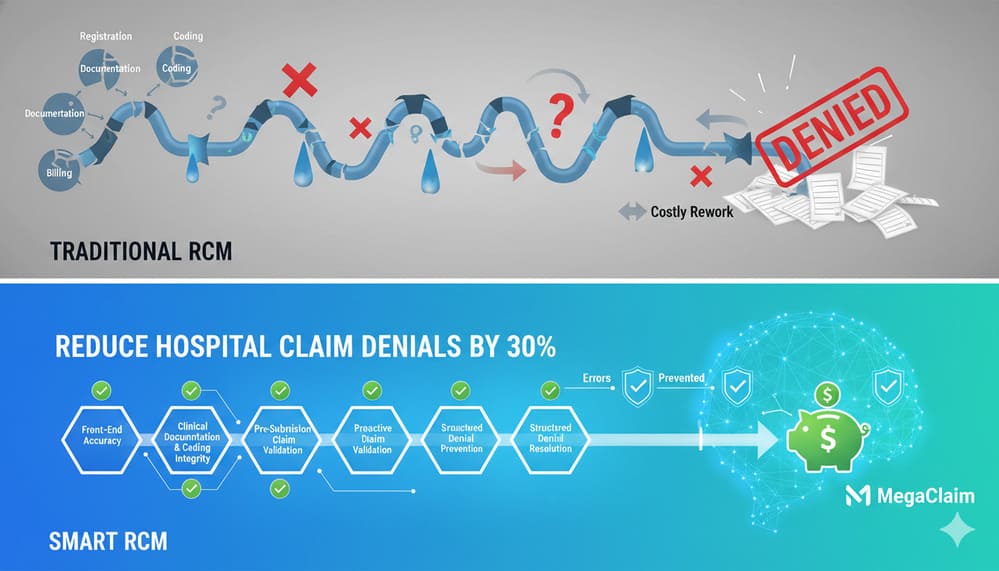
Most RCM strategies focus on fixing denials after they occur. That approach treats the symptom, not the cause.
Denial management is inherently reactive. By the time a claim is rejected, the error has already moved through multiple stages of the revenue cycle, making it more expensive and time-consuming to correct.
At the same time, fragmented workflows allow issues to pass between registration, documentation, coding, and billing without being addressed at their source. Validation happens too late, and visibility across the cycle remains limited.
As a result, the same errors repeat, despite continuous effort to resolve them.
Without addressing how the revenue cycle is designed, denial rates don’t meaningfully change.
Smart RCM: From Processing Claims to Controlling Outcomes
Traditional RCM focuses on moving claims through the system. Smart RCM focuses on controlling what happens before they ever reach the payer.
It shifts the role of RCM from execution to orchestration, where every stage of the revenue cycle is designed to prevent errors, not pass them forward.
This means decisions are made earlier. Data is validated in real time. And workflows are connected, not fragmented.
Instead of reacting to denials, Smart RCM reduces the conditions that cause them.
Errors are identified at the point of entry, corrected before submission, and tracked across the entire cycle.
The result is not just fewer denials, but a revenue cycle that is predictable, controlled, and scalable.
The Smart RCM Framework for Reducing Claim Denials
Reducing denials requires control at every stage of the revenue cycle. The impact doesn’t come from a single fix; it comes from how the entire system is structured.
A Smart RCM model focuses on five control points where most denials originate:
- Front-End Accuracy
Patient data, eligibility, and authorizations are validated before services are billed, eliminating errors at the source.
- Clinical Documentation & Coding Integrity
Documentation is standardized and aligned with coding requirements to ensure claims are complete and compliant.
- Pre-Submission Claim Validation
Claims are checked against payer-specific rules before submission, catching issues early.
- Proactive Denial Prevention
Common denial triggers are identified and addressed through built-in logic and validation rules.
- Structured Denial Resolution & Resubmission
When denials occur, they are resolved through defined workflows that prioritize speed and accuracy.
When these control points are aligned, denials become a measurable and manageable outcome.
Enabling Smart RCM with MegaClaim
Smart RCM requires a system that brings structure, visibility, and control across the entire revenue cycle.
At Megamind, we deliver this through MegaClaim, our end-to-end RCM solution designed to connect workflows, enforce validation, and reduce errors before they reach the payer.
MegaClaim supports Smart RCM by embedding key control points into daily operations:
- End-to-end claim lifecycle management: From registration to payment posting, every stage is connected and traceable.
- Built-in claim validation: Errors are identified and resolved early.
- Integrated denial management and resubmission: Denials are tracked and resolved through structured workflows.
- Real-time visibility and performance tracking: Dashboards and KPIs provide clear insight into denials, delays, and bottlenecks.
- Seamless integration with hospital systems: Ensures consistency across clinical, administrative, and financial data.
With MegaClaim as part of Megamind’s ecosystem, hospitals operate within a structured revenue cycle where errors are controlled early and denials are reduced as a result of how the system is designed.
Take Control of Your Revenue Cycle Performance
Transform how your revenue cycle operates with a system built for accuracy, visibility, and control.
At Megamind, we deliver this through MegaClaim, enabling healthcare providers to reduce claim denials, improve financial performance, and maintain consistent operational efficiency.
If your current approach is limiting results, the next step is to implement a model designed for measurable impact.
Connect with Megamind and let MegaClaim support your revenue cycle transformation.
Read More
- Predictive Analytics in Saudi Hospitals: Using Data to Save Lives
- How MegaCare Helps Saudi Hospitals Achieve JCI Accreditation
- How to Calculate ROI on Healthcare IT Investments in Saudi Arabia
- Building a Healthcare Data Warehouse for Saudi Hospitals
- Cybersecurity Frameworks for Saudi Healthcare: SAMA, NCA and PDPL Compliance