

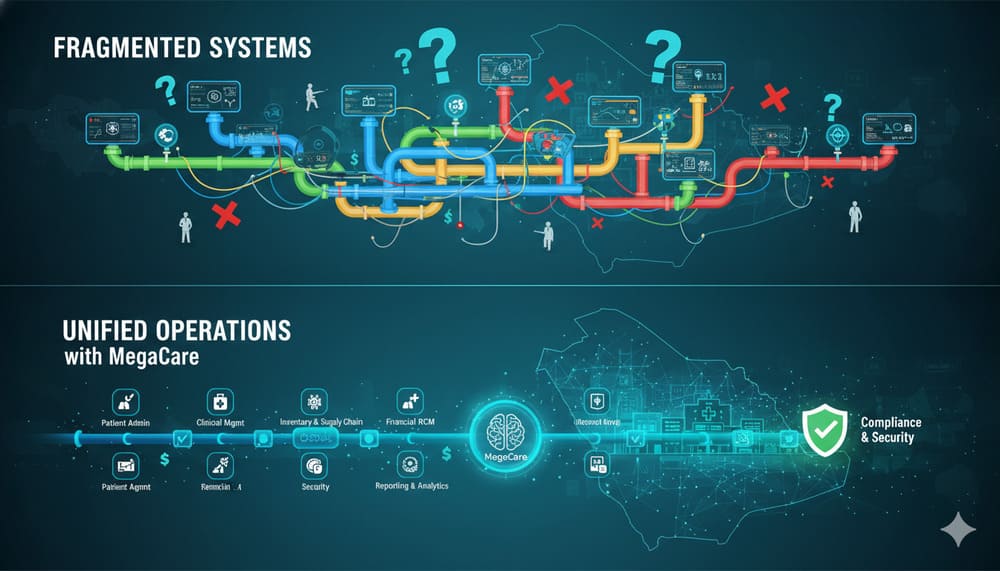
Healthcare organizations in Saudi Arabia are investing heavily in digital systems, yet many still struggle to scale their operations effectively.
The issue is not the absence of technology. Hospitals today run multiple systems across clinical care, billing, scheduling, and administration. The challenge is that these systems operate independently, creating gaps in visibility, misalignment between departments, and slower decision-making as organizations grow.
As the healthcare sector accelerates under Vision 2030, this disconnect becomes more critical. Expanding capacity without operational alignment introduces inefficiencies that directly impact performance, patient experience, and financial outcomes.
This is where ERP solutions become essential, bringing structure, visibility, and control to complex healthcare environments.
Why Hospital Operations Fail to Scale Efficiently
Scaling hospital operations is not just about handling more patients or expanding capacity. As organizations grow, operational complexity increases faster than the systems managing it.
Most hospitals rely on multiple systems across clinical, financial, and administrative functions. These systems are often implemented to solve specific needs, but they operate independently rather than as part of a unified structure. As a result, operations become harder to coordinate and control as scale increases.
This leads to a set of recurring challenges:
- Limited visibility across the organization, making it difficult to monitor performance in real time
- Misalignment between clinical and financial processes, affecting accuracy and revenue outcomes
- Inefficient use of resources, as departments operate in silos
- Delayed decision-making, due to fragmented data and manual consolidation
The issue is not growth itself, but the lack of an operational foundation designed to support it.
Core Components of a Healthcare ERP System
These challenges point to a missing layer in hospital operations: a system that connects functions into one coordinated structure.
A healthcare ERP system provides this foundation by integrating key operational areas into a single environment:
- Patient Administration (PAM): Registration, scheduling, and patient records.
- Clinical Management: EMR, LIS, RIS, and related clinical systems.
- Financial & Revenue Cycle Management: Billing, insurance, and revenue processes.
- Inventory & Supply Chain: Procurement, stock control, and utilization.
- Security & Access Control: Role-based access and compliance management.
- Reporting & Analytics: Unified visibility across operational and financial performance.
The value is not in these components individually, but in how they operate as one system, ensuring data consistency, aligned workflows, and full operational visibility.
The Real Impact of ERP on Hospital Performance
When operations are managed through a unified ERP system, the impact is immediate and measurable:
- End-to-end visibility: Leadership gains a clear, real-time view of clinical, financial, and operational performance.
- Aligned clinical and financial workflows: Activities at the point of care translate directly into accurate billing and revenue processes.
- Faster, more confident decision-making: Data is consolidated and accessible, reducing reliance on manual reporting.
- Improved resource utilization: Staffing, inventory, and facility usage are managed more efficiently across departments.
- Greater operational control at scale: Processes remain consistent and manageable as the organization grows.
ERP shifts hospital operations from fragmented execution to coordinated performance, enabling organizations to scale without losing control.
ERP and Vision 2030: Why It Matters Now
Saudi Arabia’s healthcare sector is undergoing a structural transformation driven by Vision 2030, with a strong focus on privatization, digital integration, and improved quality of care.
This shift is not only increasing demand for healthcare services, but also raising expectations around operational efficiency, transparency, and compliance. Healthcare organizations are required to operate with greater accuracy, faster reporting, and tighter coordination across clinical and financial functions.
In this environment, fragmented systems create limitations that are difficult to sustain at scale.
ERP systems play a critical role by enabling:
- Standardized and integrated operations across departments and facilities
- Compliance with national frameworks such as NPHIES and regulatory requirements
- Data-driven decision-making aligned with performance and reporting expectations
- Scalability to support expansion across multiple locations
As healthcare organizations align with Vision 2030, ERP becomes less of a technology choice and more of an operational requirement, supporting the shift toward a more connected, efficient, and accountable healthcare system.
What to Look for in a Healthcare ERP Solution
Selecting the right solution requires evaluating how well it supports integration, scalability, and control across the organization.
Key criteria to consider:
- Healthcare-specific functionality: Built to support clinical, financial, and administrative workflows, not adapted from generic ERP systems.
- Integration capabilities: Seamless connectivity with existing systems using standards such as HL7 and APIs.
- Scalability and multi-facility support: Ability to operate across hospitals, clinics, and networks without performance limitations.
- Compliance and regulatory readiness: Alignment with national frameworks such as NPHIES and data governance requirements.
- Data security and access control: Strong role-based permissions and protection of sensitive patient information.
- Usability and adoption: Intuitive interfaces that support daily workflows and reduce resistance from clinical and administrative teams.
A well-selected ERP system should not only meet current operational needs, but also provide a foundation for long-term growth and continuous improvement.
From Systems to Ecosystems: The Future of Connected Healthcare
As healthcare organizations grow, managing separate systems is no longer sufficient. The focus is shifting from operating individual platforms to building a connected ecosystem where all functions work together.
This shift is driven by the need for:
- Real-time data flow across clinical, financial, and operational systems.
- Interoperability between internal platforms and external stakeholders.
- Centralized visibility for performance monitoring and decision-making.
- Seamless integration with AI-driven tools and advanced analytics.
In this model, ERP serves as the core layer that connects and coordinates all parts of the organization. It enables hospitals to move beyond managing isolated processes toward operating as a unified, data-driven system.
How MegaCare Enables End-to-End Operations
As part of Megamind’s healthcare ecosystem, MegaCare unifies hospital operations within a single system, connecting clinical, financial, and administrative functions with full visibility and control.
Key capabilities include:
- Integrated patient administration and clinical systems: Connects registration, scheduling, EMR, LIS, and RIS to ensure a continuous flow of accurate patient data.
- End-to-end financial and revenue cycle management: Aligns billing, insurance, and revenue processes with clinical activities to improve accuracy and cash flow.
- Centralized reporting and analytics: Provides real-time dashboards across operational, clinical, and financial performance for informed decision-making.
- Multi-facility support: Enables consistent operations across hospitals, clinics, and healthcare networks.
- Interoperability and system integration: Supports integration with external systems and medical equipment for a connected healthcare environment.
- Scalable deployment models: Available as SaaS, on-premise, or cloud-based solutions to meet different organizational needs.
By bringing all operational layers into one system, MegaCare enables healthcare organizations to move from fragmented workflows to a structured, coordinated, and scalable operating model.
Transform Your Hospital Operations with MegaCare
Take control of your hospital operations and remove the inefficiencies that limit performance at scale. As complexity increases, success depends on how well your clinical, financial, and administrative workflows operate as one.
MegaCare enables you to align these operations within a single system, giving your leadership team the visibility, control, and consistency needed to improve outcomes and manage growth with confidence.
Replace fragmented processes with a structured, scalable operational model built for modern healthcare.
Connect with Megamind today to see how MegaCare can support your organization’s next stage of growth.
Read More
- Predictive Analytics in Saudi Hospitals: Using Data to Save Lives
- How MegaCare Helps Saudi Hospitals Achieve JCI Accreditation
- How to Calculate ROI on Healthcare IT Investments in Saudi Arabia
- Building a Healthcare Data Warehouse for Saudi Hospitals
- Cybersecurity Frameworks for Saudi Healthcare: SAMA, NCA and PDPL Compliance