
For small clinics in Saudi Arabia, NPHIES compliance extends beyond meeting regulatory requirements. It directly influences claim acceptance rates, reimbursement timelines, and the efficiency of day-to-day revenue cycle operations.
While the requirements are standardized, achieving compliance can be more challenging for smaller healthcare providers that often operate with limited administrative resources and lean billing teams. Understanding the key requirements and implementing the right processes is essential to maintaining compliance, reducing claim rejections, and supporting sustainable financial performance.
Why NPHIES Compliance Can Be Challenging for Small Clinics
Unlike larger hospitals that often have dedicated revenue cycle and compliance teams, small clinics typically manage the same regulatory requirements with fewer administrative resources and leaner billing operations. As a result, maintaining NPHIES compliance can be more challenging, particularly when processes are heavily dependent on manual workflows.
Common challenges include:
- Maintaining accurate patient and insurance information across all transactions.
- Ensuring consistent medical coding and clinical documentation practices.
- Managing eligibility verification and authorization requirements efficiently.
- Reducing claim rejections caused by incomplete or inaccurate submissions.
- Tracking claims, denials, and resubmissions throughout the reimbursement cycle.
- Keeping pace with evolving payer and compliance requirements.
Without standardized processes and effective oversight, these challenges can increase administrative workload, delay reimbursements, and make ongoing compliance more difficult to maintain.
Essential NPHIES Compliance Requirements for Small Clinics
Maintaining NPHIES compliance requires small clinics to align their administrative, clinical, and billing processes with standardized requirements. While workflows may vary between providers, several core areas are essential for supporting compliant and efficient insurance transactions:
- Accurate patient registration and insurance verification to ensure claims are supported by correct demographic and coverage information.
- Standardized medical coding and clinical documentation to improve claim accuracy and meet payer requirements.
- Eligibility, authorization, and approval management to ensure required verifications are completed before services are delivered.
- Electronic claims submission through structured workflows that minimize errors and reduce processing delays.
- Claims monitoring and denial management to identify submission issues, resolve rejected claims, and support reimbursement performance.
- Secure data exchange and record management to maintain accurate, accessible, and protected patient and financial information.
Common Compliance Mistakes That Lead to Claim Rejections
While these requirements form the foundation of NPHIES compliance, many claim issues stem from routine administrative and process-related errors rather than complex technical challenges.
Common compliance mistakes include:
- Incomplete or inaccurate patient information that creates discrepancies during eligibility verification and claims processing.
- Coding and documentation inconsistencies that fail to fully support the services provided.
- Missing eligibility checks or authorization requirements before treatment is delivered.
- Submitting claims with incomplete or incorrect data, increasing the likelihood of rejection or delay.
- Delays in claim submission that impact reimbursement timelines and administrative efficiency.
- Limited visibility into claim status, denials, and resubmissions, making it difficult to identify recurring issues and improve performance.
A Practical Step-by-Step Approach to NPHIES Compliance
- Evaluate Current Administrative and Billing Processes
Review existing registration, documentation, eligibility verification, and claims workflows to identify compliance gaps and recurring issues.
- Standardize Data Collection and Documentation Practices
Establish consistent procedures for patient registration, insurance verification, clinical documentation, and medical coding.
- Train Staff on NPHIES Requirements and Workflows
Ensure administrative, clinical, and billing teams understand compliance requirements and follow standardized processes.
- Automate Eligibility Verification and Claims Processing
Leverage technology to streamline eligibility checks, claims validation, and submission workflows while reducing manual errors.
- Monitor Performance and Address Compliance Gaps
Track claim rejections, denials, reimbursement timelines, and workflow performance to identify opportunities for improvement.
How Revenue Cycle Management Supports NPHIES Compliance
Revenue Cycle Management plays a central role in maintaining NPHIES compliance by ensuring that insurance-related processes are accurate, consistent, and aligned with standardized requirements throughout the patient journey.
From eligibility verification and clinical documentation to coding, claims submission, and denial management, each stage of the revenue cycle contributes to compliance performance. When these processes are managed effectively, clinics can reduce administrative errors, improve claim quality, and minimize reimbursement delays.
A structured RCM approach also provides greater visibility into claims performance, enabling clinics to identify recurring issues, address compliance gaps, and maintain more efficient interactions with payers. As NPHIES requirements continue to shape healthcare transactions in Saudi Arabia, strong revenue cycle management becomes an essential component of both compliance and financial performance.
How MegaClaim Helps Small Clinics Simplify NPHIES Compliance
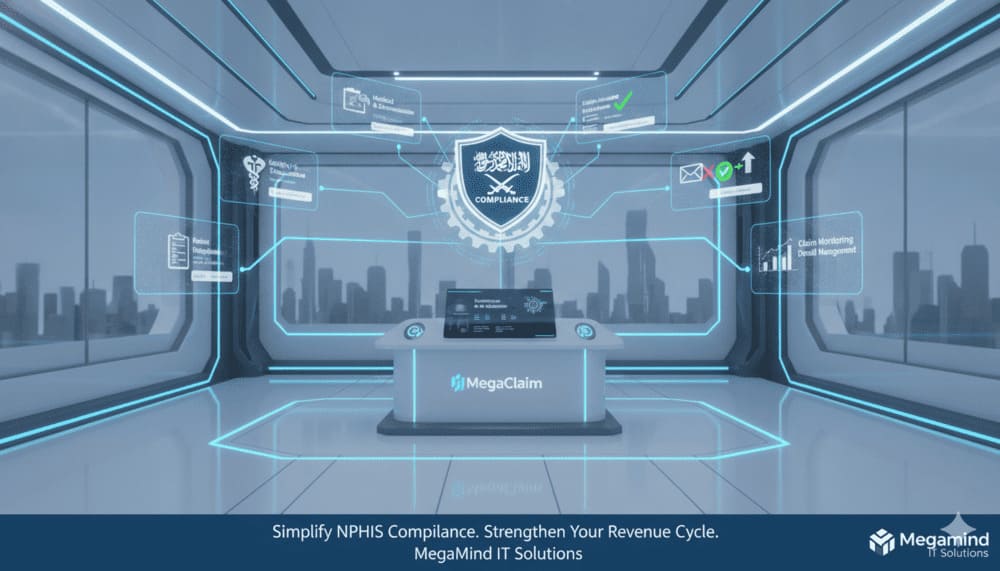
MegaClaim helps small clinics simplify NPHIES compliance by bringing eligibility verification, claims management, submission, denial management, and reporting into a single Revenue Cycle Management solution.
The platform supports key NPHIES services, including eligibility checks, pre-approvals, and claims submission, while providing claims management capabilities, performance dashboards, and reporting tools. By centralizing these functions, clinics can manage compliance-related processes more effectively and maintain greater visibility across the revenue cycle.
As part of Megamind’s healthcare technology portfolio, MegaClaim enables healthcare providers to streamline insurance workflows while supporting ongoing compliance requirements.
Building a More Efficient and Compliant Clinic Operation
For small clinics, achieving NPHIES compliance is not simply about meeting current requirements. It is about building the operational foundation needed to support sustainable growth in an increasingly connected healthcare ecosystem.
Clinics that establish standardized processes, maintain data quality, and adopt a proactive approach to compliance are better positioned to manage change, adapt to evolving payer requirements, and maintain greater control over their financial operations.
Through MegaClaim, Megamind helps healthcare providers strengthen the processes that support compliance, operational efficiency, and long-term revenue cycle performance.
Simplify NPHIES compliance and strengthen your revenue cycle with MegaClaim. Partner with Megamind to build a more efficient, compliant, and financially resilient clinic operation.
Read More
- Predictive Analytics in Saudi Hospitals: Using Data to Save Lives
- How MegaCare Helps Saudi Hospitals Achieve JCI Accreditation
- How to Calculate ROI on Healthcare IT Investments in Saudi Arabia
- Building a Healthcare Data Warehouse for Saudi Hospitals
- Cybersecurity Frameworks for Saudi Healthcare: SAMA, NCA and PDPL Compliance