

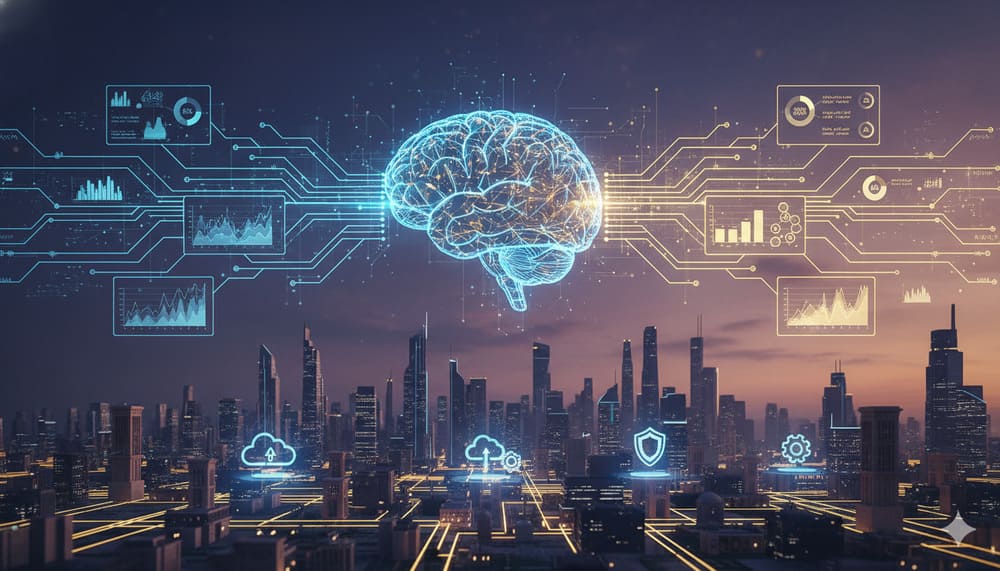
ERP systems were built to organize operations but in today’s environment, organization alone is no longer enough.
Enterprises are dealing with growing data volumes, faster decision cycles, and increasing pressure to respond in real time. Yet many ERP systems still operate as static repositories, capturing data without fully enabling action. The result is a gap between what businesses know and how quickly they can act on it.
This is where the shift begins. By integrating artificial intelligence and business intelligence, ERP evolves from a system of record into a predictive, decision-driven engine. Organizations that embrace this shift don’t just improve efficiency; they gain the clarity and speed needed to compete at scale.
How AI Transforms ERP into a Predictive Decision Engine
AI shifts ERP from a system that reports what happened to one that anticipates what’s next.
Instead of relying solely on historical data, AI analyzes patterns across financial, operational, and supply chain data to generate predictive insights. This enables organizations to forecast demand, identify risks early, and optimize resources before issues arise. Decision-making becomes faster, more accurate, and more strategic.
AI also introduces intelligent automation into ERP workflows. Routine processes such as data entry, reconciliation, and exception handling can be executed with minimal human intervention, reducing errors and improving efficiency at scale.
In parallel, AI enhances real-time responsiveness through continuous monitoring and anomaly detection. ERP systems can flag irregularities, surface risks, and trigger actions as events unfold, rather than after the fact.
This changes how decisions are made, shifting ERP from a reporting layer to a continuous decision support system.
How Business Intelligence Unlocks Real-Time ERP Insights
While AI enables prediction and automation, business intelligence ensures data is visible and actionable across the organization.
ERP systems generate large volumes of data, but without BI, much of it remains underused. BI transforms this data into real-time insights through dashboards and visualizations that support faster, more informed decisions.
Instead of relying on static reports, organizations gain continuous visibility into key areas such as:
- Financial performance
- Operational efficiency
- Supply chain activity
This allows leaders to track KPIs in real time, identify issues early, and respond with precision.
BI also creates a unified view across departments, ensuring decisions are based on consistent, reliable data rather than fragmented inputs.
With BI integrated into ERP, data becomes a day-to-day decision tool, not just a reporting function.
The Real Business Impact of AI and BI in ERP
Integrating AI and BI into ERP systems doesn’t just improve how data is processed; it reshapes how organizations operate and compete.
With access to predictive insights and real-time visibility, decision-making becomes faster, more precise, and less dependent on manual analysis. Leaders can act earlier, reduce uncertainty, and align strategies with actual business conditions rather than delayed reports.
At an operational level, this translates into:
- Improved efficiency through automation and streamlined workflows.
- Better cost control with clearer visibility into spending and resource allocation.
- Stronger financial performance driven by more accurate forecasting and planning.
- Greater organizational alignment through shared, real-time data across departments.
These improvements are not incremental. They directly impact how businesses scale, respond to change, and maintain a competitive edge in increasingly complex markets.
Building a Connected ERP Ecosystem with Megamind
ERP systems deliver the most value when they are connected to a broader ecosystem of data, intelligence, and infrastructure.
Megamind enables this shift by integrating ERP capabilities with advanced technologies that enhance visibility, automate workflows, and support real-time decision-making, turning disconnected systems into a unified, high-performing environment.
Within the Megamind ecosystem, this approach is brought together through MegaERP, Megamind’s integrated ERP platform that unifies data, operations, and decision-making in a single connected system.
Within the Megamind ecosystem, ERP capabilities are extended through:
- MegaAI, delivering predictive insights that enable earlier and more accurate decisions.
- MegaOutsource, optimizing operations through automation, reporting, and process efficiency.
- MegaCloud, providing secure, scalable infrastructure for real-time data access and performance.
- MegaCare and MegaClaim, connecting clinical, operational, and financial data where healthcare integration is required.
This integrated approach positions ERP as part of a connected, intelligent ecosystem where data flows seamlessly, decisions are aligned, and performance is continuously optimized.
Overcoming Key ERP Transformation Challenges
Despite the advantages of AI- and BI-powered ERP systems, many organizations struggle to realize their full value due to foundational gaps.
Key barriers include:
- Fragmented systems and data silos, which limit visibility and prevent a unified view of operations. Overcoming this requires integrating systems into a connected architecture where data flows seamlessly across functions.
- Limited real-time visibility, where reliance on delayed reporting slows decision-making. This can be addressed by enabling real-time analytics and centralized dashboards that provide continuous insight.
- Manual processes and workflow inefficiencies, which increase errors and restrict scalability. Streamlining operations through automation helps reduce friction and improve consistency.
- Low adoption and resistance to change, where teams struggle to adapt to new systems. This is best managed through user-focused implementation, training, and structured change management.
- Security and compliance complexities, particularly as systems become more interconnected. Strengthening data governance, access control, and security frameworks is essential to mitigate risk.
Future Trends: AI-Driven ERP and Autonomous Decision Systems
ERP systems are evolving toward models where decision-making becomes more automated, continuous, and data-driven.
AI is moving beyond prediction to recommending actions, simulating outcomes, and executing decisions with minimal human input. This allows organizations to respond faster and reduce reliance on manual analysis.
At the same time, real-time data integration is enabling fully connected environments, where decisions are informed by a constant flow of operational and financial insights.
We are also seeing the rise of autonomous workflows, where processes adapt dynamically based on performance and changing conditions.
ERP is no longer just supporting decisions; it is becoming an active part of how decisions are made.
Turn Your ERP into a Competitive Advantage
Unlock the full potential of your ERP by turning it into a driver of faster, smarter decisions across your organization.
With Megamind’s integrated ecosystem, you can connect data, intelligence, and operations in one unified environment powered by AI, advanced analytics, and scalable infrastructure. This enables your ERP to move beyond static processes and support real-time, high-impact decision-making.
Partner with Megamind to transform your ERP into a fully connected, intelligent system that drives performance, efficiency, and sustainable growth.
Read More
- Predictive Analytics in Saudi Hospitals: Using Data to Save Lives
- How MegaCare Helps Saudi Hospitals Achieve JCI Accreditation
- How to Calculate ROI on Healthcare IT Investments in Saudi Arabia
- Building a Healthcare Data Warehouse for Saudi Hospitals
- Cybersecurity Frameworks for Saudi Healthcare: SAMA, NCA and PDPL Compliance