
Healthcare organizations don’t operate like typical enterprises. Every decision directly impacts patient care, resource availability, and regulatory compliance.
Yet many providers still rely on traditional ERP systems that treat departments as separate functions, creating delays, limited visibility, and reliance on manual coordination. In an environment where timing and accuracy are critical, this quickly becomes a constraint.
As healthcare systems grow in complexity, the need shifts from managing processes to coordinating operations in real time. This requires a system that aligns financial control, workforce planning, and resource management within a single operational model.
The Challenge of Fragmented Systems in Healthcare
Healthcare organizations rely on multiple systems to manage clinical, financial, and operational functions. However, these systems often operate in isolation, creating gaps between departments that depend on shared information.
When systems are not aligned, organizations face challenges such as:
- Delayed decision-making, due to reliance on manual data reconciliation.
- Inconsistent data across departments, reducing trust in reporting and insights.
- Limited visibility into performance, making it difficult to track operations in real time.
- Operational misalignment, where staffing, procurement, and financial planning are not synchronized
As complexity increases, these disconnects become harder to manage. What begins as manageable inefficiency quickly evolves into a structural barrier to performance, limiting the organization’s ability to operate with clarity, control, and speed.
Enabling Real-Time Financial and Operational Control
In healthcare, financial and operational decisions are closely linked, yet control is often applied after the fact through reports and audits. This delay limits cost control and makes decisions reactive.
A more effective approach is to embed financial control directly into daily operations. When financial data aligns with workforce activity, procurement, and service delivery in real time, organizations gain immediate visibility into cost and performance.
This allows healthcare providers to:
- Monitor spending in real time
- Align budgets with operational activity
- Enforce controls at the point of execution
This shift enables more precise, consistent decision-making across departments.
Aligning Workforce, Resources, and Patient Demand
Healthcare operations depend on how effectively workforce capacity aligns with patient demand. When HR data is disconnected from operational and financial systems, staffing decisions are made without full visibility into actual needs or constraints.
This leads to imbalances, overstaffing in some areas, shortages in others, and inefficient use of resources. The impact is not only financial but also affects the quality and responsiveness of care.
With MegaERP, workforce data is connected to real-time operational activity and financial planning. Staffing decisions reflect actual demand, available capacity, and budget constraints as they evolve.
This alignment allows healthcare organizations to manage resources more efficiently while maintaining consistent care delivery.
Improving Procurement and Inventory in Clinical Environments
In healthcare, procurement decisions must reflect real demand, available inventory, and budget constraints at the time they are made. When these elements are disconnected, purchasing is often based on estimates rather than actual needs.
This results in over-ordering, stock shortages, and limited visibility into inventory usage, affecting both cost control and care delivery.
With MegaERP, procurement and inventory operate within the same system as financial and operational data. Purchasing decisions align with real demand, current stock levels, and approved budgets in real time.
This improves inventory accuracy, reduces waste, and ensures critical supplies are available without unnecessary spending.
Supporting Compliance and Governance in Healthcare Systems
Healthcare organizations operate under strict regulatory requirements, where financial accuracy, data security, and auditability are critical. However, when systems are fragmented, enforcing policies consistently becomes difficult, and compliance often relies on manual checks and after-the-fact reviews.
This increases the risk of errors, gaps in accountability, and delayed issue detection.
A more effective approach is to embed governance directly into operational workflows. When access controls, approval rules, and compliance requirements are applied within the system as actions occur, organizations can ensure consistency without relying on manual intervention.
This enables continuous oversight, clearer accountability, and more reliable audit trails across departments, supporting compliance without slowing down operations.
MegaERP as a Unified Operational Backbone for Healthcare
Healthcare operations depend on multiple functions working in sync, when these functions operate across separate systems, coordination becomes difficult and decisions rely on fragmented data.
A unified ERP approach brings these functions together within a single system of record, where data is shared, controls are consistent, and activity is visible in real time. Financial transactions, staffing changes, and supply movements are no longer processed in isolation, but reflected across the organization as they occur.
MegaERP serves as this operational backbone, aligning core business functions within one connected environment. This structure reduces reliance on manual reconciliation, strengthens coordination across departments, and ensures that decisions are based on current, accurate data.
Integrating MegaERP Within the Megamind Healthcare Ecosystem
Healthcare operations do not rely on ERP alone. Clinical systems, patient engagement platforms, revenue cycle processes, and IT infrastructure all play a critical role in delivering care and managing performance.
For ERP to deliver full value, it must operate within a broader, connected environment where data flows seamlessly across systems.
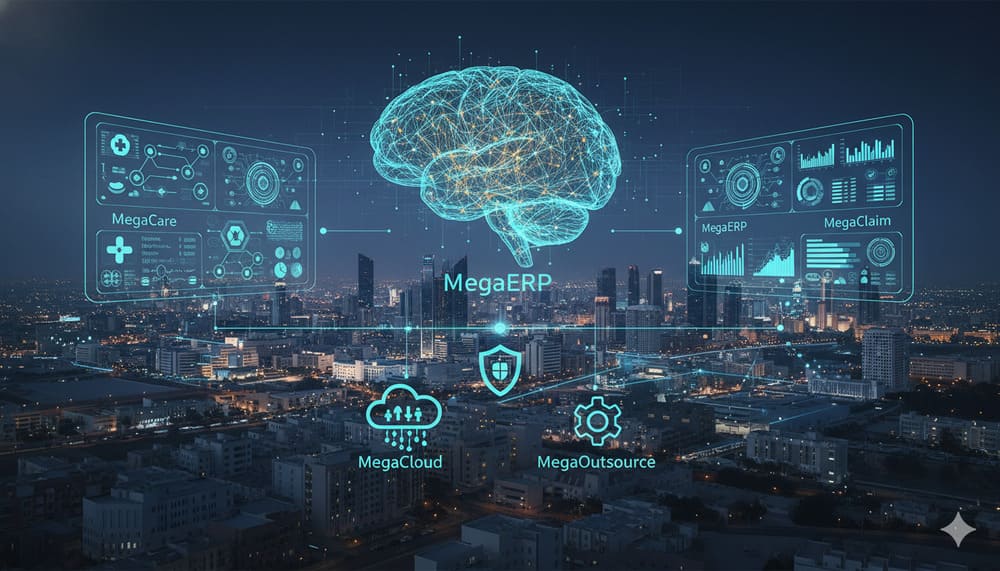
Within the Megamind ecosystem, ERP capabilities are integrated alongside clinical, financial, and infrastructure layers to support a more coordinated approach to managing both patient and operational data.
- MegaCare connects clinical and administrative workflows, ensuring alignment between care delivery and operations
- MegaClaim supports revenue cycle processes, linking financial performance with service activity
- MegaCloud provides the infrastructure, security, and scalability required to support healthcare environments
- MegaOutsource extends operational capabilities through managed services and ongoing support
This ecosystem approach ensures that ERP is not isolated, but part of a unified environment where clinical, financial, and operational systems work together to support more effective healthcare delivery.
Build a Smarter Healthcare Operation with MegaERP
Transform how your healthcare organization operates by connecting systems, data, and decisions within a unified environment.
With Megamind’s integrated solutions, you can align financial control, workforce planning, and operational performance while maintaining the flexibility and security healthcare environments require. This enables faster decisions, stronger governance, and more consistent care delivery.
Partner with Megamind to build a healthcare operation that is more connected, efficient, and ready to scale.
Read More
- Predictive Analytics in Saudi Hospitals: Using Data to Save Lives
- How MegaCare Helps Saudi Hospitals Achieve JCI Accreditation
- How to Calculate ROI on Healthcare IT Investments in Saudi Arabia
- Building a Healthcare Data Warehouse for Saudi Hospitals
- Cybersecurity Frameworks for Saudi Healthcare: SAMA, NCA and PDPL Compliance