Remote patient monitoring is redefining how healthcare providers deliver care beyond traditional clinical settings. By combining wearable technologies, connected medical devices, and advanced analytics, healthcare organizations can gain continuous visibility into patient health while improving efficiency, responsiveness, and outcomes.
In Saudi Arabia, the growing focus on digital health transformation is accelerating the adoption of wearables and Internet of Medical Things (IoMT) solutions. As healthcare providers seek to expand access to care and support more proactive interventions, these technologies are becoming increasingly important components of modern healthcare delivery.
What Are Wearables and the Internet of Medical Things (IoMT)?
Wearable devices and the Internet of Medical Things (IoMT) are key technologies enabling healthcare organizations to monitor patients beyond traditional care settings.
Wearables are connected devices worn by patients, such as smartwatches, cardiac monitors, continuous glucose monitors, and other sensor-based technologies that capture health data in real time. The Internet of Medical Things (IoMT) is the broader ecosystem that connects these devices with healthcare applications, clinical platforms, and hospital systems, allowing information to be securely transmitted, analyzed, and shared.
In practice, IoMT supports a wide range of healthcare applications, including remote patient monitoring, chronic disease management, medication tracking, connected ambulances, and the integration of wearable health data.
How Wearables and IoMT Are Transforming Patient Care
Wearables and IoMT technologies are changing how healthcare providers monitor, engage with, and support patients throughout their care journeys. Instead of relying solely on data collected during clinical visits, providers can access a more continuous view of patient health, enabling a shift from reactive treatment to proactive care.
This increased visibility can be particularly valuable for managing chronic conditions, supporting post-discharge follow-up, and identifying potential health concerns before they escalate. By extending monitoring beyond hospitals and clinics, healthcare organizations can improve care continuity while helping patients remain more actively involved in managing their health.
As adoption continues to grow, wearables and IoMT are creating new opportunities to enhance patient outcomes, optimize healthcare resources, and deliver more personalized care experiences.
How IoMT Enables Continuous Monitoring at Scale
One of the most significant advantages of IoMT is its ability to support continuous monitoring across large patient populations. Connected devices can automatically collect and transmit health data to centralized healthcare platforms, reducing the need for manual data collection and enabling more efficient oversight.
Rather than relying solely on information gathered during clinical encounters, healthcare organizations can access ongoing streams of patient data from multiple sources. This creates greater visibility across remote care programs and helps clinical teams identify patients who may require attention.
As remote monitoring initiatives expand, IoMT provides the connectivity and infrastructure needed to support scalable, data-driven healthcare delivery.
The Role of AI in Turning Wearable Data into Clinical Insights
While wearables and IoMT devices generate vast amounts of health data, collecting information alone is not enough. The real value lies in the ability to analyze that data, identify meaningful patterns, and translate insights into informed clinical actions.
Artificial intelligence helps healthcare organizations unlock greater value from remote monitoring programs by:
- Identifying trends and changes in patient health that may require attention.
- Detecting potential risks earlier through continuous data analysis.
- Prioritizing critical cases and reducing the burden of manual data review.
- Supporting more informed and timely clinical decision-making.
As remote monitoring initiatives expand, AI enables healthcare providers to manage growing volumes of patient data more efficiently while focusing attention where it can have the greatest impact.
Healthcare Applications of Wearables and IoMT
The combination of wearables, IoMT, and AI is creating new opportunities to enhance patient care across a wide range of healthcare settings. By providing continuous access to patient data and actionable insights, these technologies support more proactive and connected models of care.
Key applications include:
- Chronic Disease Management: Supporting ongoing monitoring of conditions such as diabetes, hypertension, and cardiovascular disease through connected devices and real-time data collection.
- Cardiac Monitoring: Tracking heart rate, rhythm, and other vital indicators to help identify abnormalities and support timely intervention.
- Post-Discharge Follow-Up: Monitoring patients after hospitalization to support recovery, improve care continuity, and reduce the risk of readmissions.
- Elderly and Home-Based Care: Enabling healthcare providers to remotely monitor vulnerable populations while helping patients maintain greater independence.
- Telehealth and Virtual Care Programs: Enhancing virtual consultations with real-time health data from connected devices, allowing clinicians to make more informed decisions.
Building a Scalable Remote Monitoring Strategy
Implementing remote patient monitoring at scale calls for a coordinated approach that connects patients, care teams, and clinical systems while supporting efficient and informed care delivery.
Key considerations for building a scalable remote monitoring strategy include:
- Unified Data Connectivity: Connecting wearable devices, IoMT platforms, and clinical systems to create a centralized view of patient information.
- Intelligent Data Analysis: Transforming continuous streams of health data into actionable insights that support timely clinical decision-making.
- Clinical Workflow Integration: Embedding remote monitoring processes into existing care pathways to enhance efficiency and care coordination.
- Security and Regulatory Compliance: Protecting sensitive patient data while meeting healthcare privacy, security, and governance requirements.
- Scalable Infrastructure: Supporting growing patient populations and expanding remote care programs without compromising performance or quality of care.
When these elements work together, healthcare organizations are better positioned to expand remote monitoring initiatives, improve visibility into patient health, and support more proactive care delivery across diverse healthcare settings.
How MegaAI Supports Intelligent Remote Patient Monitoring
As part of Megamind’s healthcare technology portfolio, MegaAI helps healthcare organizations leverage wearable devices and IoMT ecosystems through advanced AI-powered capabilities.
Key MegaAI capabilities that support remote monitoring initiatives include:
- AI-Powered Analytics: Converting patient data into actionable insights.
- Clinical Decision Support: Helping healthcare teams identify trends and potential risks.
- Remote Monitoring Enablement: Supporting connected care beyond traditional healthcare settings.
- AI-Driven Telehealth Solutions: Including AI Tele-ICU, AI Tele-Cardiology, AI Tele-Radiology, and AI Tele-Stroke.
By combining AI with connected healthcare technologies, MegaAI helps providers deliver more informed, efficient, and scalable care.
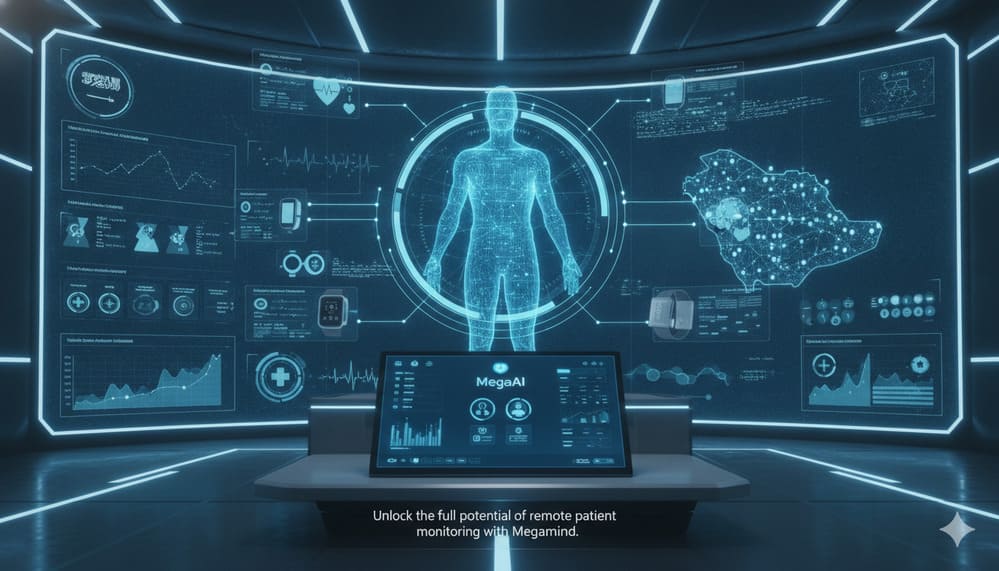
Unlock the full potential of remote patient monitoring with Megamind’s AI-powered solutions for connected, data-driven healthcare.
Read More
- Predictive Analytics in Saudi Hospitals: Using Data to Save Lives
- How MegaCare Helps Saudi Hospitals Achieve JCI Accreditation
- How to Calculate ROI on Healthcare IT Investments in Saudi Arabia
- Building a Healthcare Data Warehouse for Saudi Hospitals
- Cybersecurity Frameworks for Saudi Healthcare: SAMA, NCA and PDPL Compliance